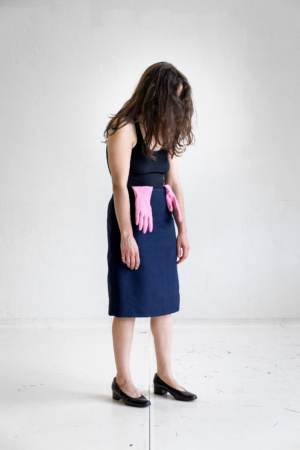


Inès Mauricio
Chega de saudade
danse
- 45'
- F Hearing-impaired spectators welcome
- B Accessible to persons with reduced mobility
Choreography, Artistic Direction, and Performance: Inès Mauricio
Lighting Design: Eduardo Abdala
Music Composition and Artistic Collaboration: Mackenzy Bergile
Photography and Artistic Collaboration: Neige Sanchez
Delegate Production: Collectif Fair-e / National Choreographic Center (CCN) of Rennes and Brittany, Rennes
Co-productions: Arsenic – Centre for Contemporary Performing Arts, Lausanne
Support: Regional Directorate of Cultural Affairs (DRAC) of Brittany
Curated by: Diana Akbulut
With Chega de saudade, Inès Mauricio questions her Portuguese heritage through the lens of her family narrative, exploring the various postures inherited and passed down through generations. She sketches a portrait of the Salazarist colonial period in Angola by drawing on the story of her grandmother, “Avó,” who was among those Portuguese who settled in Angola in search of renewed social status.
From this perspective, Inès creates an intimate portrait of her family legacy, like a photo album one flips through with nostalgia. And as we move through these images, we almost find ourselves in the shoes of those we remember. We celebrate their successes, we mourn their losses. But when the perspective shifts, should we instead mourn their successes and celebrate their losses? How can one find their place between intimate memory and collective memory?
Inès Mauricio is a multifaceted Swiss-Portuguese artist, performer, choreographer, photographer, and DJ — whose performative practice weaves together body, image, and space as tools for excavating intimate, collective, and sensory narratives.
Playing with the tension between the infra-ordinary and surrealism, she explores how the body appears — in ways that are situated, porous, and reflective. Her artistic journey is rooted in the legacy of the 1970s, at the intersection of emerging hip-hop culture — as a bodily language and space of reclamation in resonance with racial, social, and urban struggles — and American conceptual art, where the body becomes medium, apparatus, and critical material of a society whose normative stance stifles the invisible, silent, or unassignable needs of bodies.
Her works unfold through subtle shifts between posture and gesture, presence and withdrawal, opacity and transparency. Through minimalist forms — videos, photographs, site-specific performances — she constructs a dramaturgy of almost nothing, where the body becomes a living archive, a surface of interference between conscious language and embodied memory.
It is through this approach to archiving that she develops a pedagogical intent, exploring various modes of transmission, including writing articles and immersive editions in the journal Regard Sur Le Geste, where she traces the imprint of her critical thinking on artistic and societal issues.