Samir Laghouati-Rashwan
Acting Fantasma
performance, dance
- 22'
- F Hearing-impaired spectators welcome
- G Hearing loops
- A Little or no text
Written and Directed by: Samir Laghouati-Rashwan
Choreography: Samir Laghouati-Rashwan, Trésor Gennai Yahaut, Manu Garcia Mpassi
Sound: Low Jack
Coproductions and Support: Arsenic — Centre d’art scénique contemporain, Lausanne Actoral, Marseille
How can we exit the stereotypes put upon us?
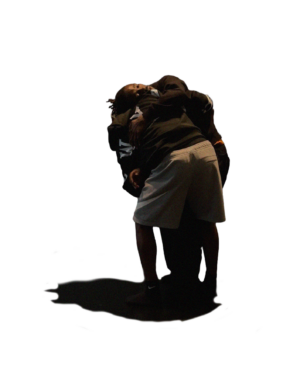
Acting Fantasma starts with the idea of video games. Three avatars emerge to explore the way identities are constructed, negotiated and replayed with the effects of social representations.
The project questions injunctions weighing on BIPOC men, often assigned contradictory figures. Strength or nonchalance, impassibility or availability, mastery or mockery. Between these extremes, bodies become spaces where expectations are laid – either as projections or stereotypes. The choreographic language and the words spoken are anchored where race and gender are crystallised, revealing the made-up mechanism and performativity of identities.
The research is also based on viral TikTok dances, analysed as if they were contemporary archives. Those choreographies speak about the spread of social norms, models of identification and strategies of visibility. They reveal how individual shape their own image, expose their bodies and work through social norms present in both virtual and social spaces.
______________________________________________________
Biography
Samir Laghouati-Rashwan
Born in 1992, Samir Laghouati-Rashwan is a French-Moroccan and Egyptian artist and performer who lives and works between Marseille and Tirana. A graduate of the Institut National Supérieur d’Enseignement Artistique Marseille-Méditerranée (INSEAMM), his practice spans installation, video, text, and performance. His work explores points of friction between identity, collective memory, and social representation. He examines the implicit power structures embedded in dominant narratives, whether related to colonial history, migration, gender, or cultural systems of legitimacy. His approach often centers on marginal figures, found objects, and reclaimed archives, which he manipulates to bring alternative narratives to the surface. He creates spaces where the tensions between presence and absence, visibility and invisibility, and the personal and the political become tangible. Rejecting fixed categories, his practice functions as an attempt to unlearn normative ways of seeing. It is driven by a desire for symbolic repair, while also employing a subtle irony that disrupts conventional readings. Through understated gestures and more confrontational stagings alike, Laghouati-Rashwan proposes fragile yet persistent forms of appearance that demand the viewer’s attention and engagement. His recent solo and group exhibitions include presentations at Salts (Basel, Switzerland), Foto Arsenal (Vienna, Austria), Maison Européenne de la Photographie (Paris, France), Triennale Milano (Milan, Italy), Neue Gesellschaft für Bildende Kunst (Berlin, Germany), Material Art Fair (Mexico City, Mexico), P21 Gallery (London, United Kingdom), Les Urbaines (Lausanne, Switzerland), Parc de la Villette (Paris, France), MRAC Occitanie (Sérignan, France), Rencontres d’Arles (Arles, France), CAC Brétigny (Brétigny, France), Art-O-Rama (Marseille, France), Triangle-Astérides (Marseille, France), and SISSI Club. Laghouati-Rashwan has also participated in residencies at the Institut Français de Tanger (Tangier, Morocco), the Cité internationale des arts (Paris, France), the Ateliers de la Ville de Marseille (Marseille, France), La Becque (Vevey, Switzerland), IASPIS (Stockholm, Sweden), and Villa Albertine in Houston, United States.